SiliconANGLE AI ↗ · 2026-11-20 07:11 · UTC+8
Resolve AI’s SRE-1 model finds root causes of production alerts as AI agents go on call
Media reports SiliconANGLE AI Source language: English
Resolve AI unveiled the 27‑billion‑parameter SRE‑1 model and Primary On‑call service that automatically diagnose production alerts. Pass rate rose from 6.9% to 38.8%, with up to 80% of alerts handled without escalation and a ten‑fold reduction in mean time to resolution.
Full text
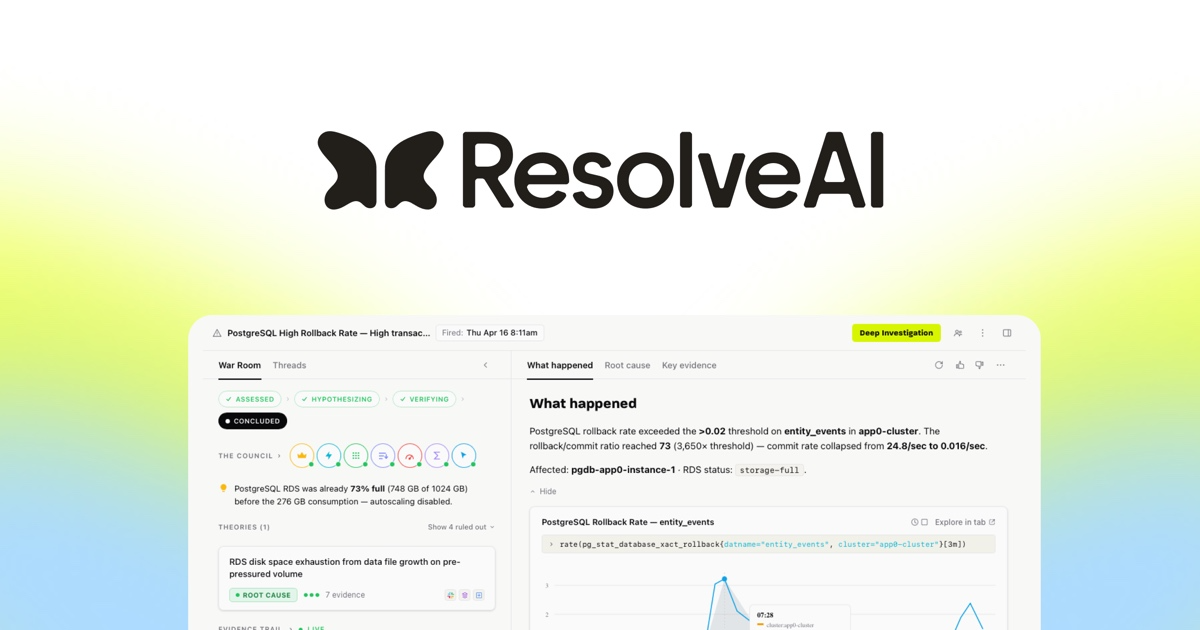
Incident remediation company Resolve AI Inc. has announced the launch of SRE-1, a new model that has been trained to find the root cause of production alerts, and Primary On-call, a new service that puts its artificial intelligence agents on call ahead of human engineers.
The new model, announced Wednesday, reflects the company’s argument that while AI has transformed how software gets written, it has barely touched how software gets run. According to Resolve AI, production has no public training corpus to match the published code that models learned from, as incidents at each company stay private.
SRE-1 is a 27 billion-parameter model built on open weights and trained by a team of 16 AI researchers over a final run of 7.4 days on up to 512 graphics processing units. Measured on the same incidents before and after training, which used reinforcement learning alone, the pass rate for a single investigation rose from 6.9% to 38.8%.
Resolve AI used Snowflake Inc.’s Cortex Training, a serverless service for customizing open-weight models, to build SRE-1. Snowflake Senior Vice President of Engineering Vivek Raghunathan said Resolve AI was the first design partner for the service.
In testing on 49 difficult live production cases, each run five times, an ensemble of five SRE-1 investigations matched the strongest frontier model tested at a lower cost, according to the company. Resolve AI also benchmarked its complete system on 178 production alert investigations, solving about twice as many incidents as general-purpose coding agents.
Primary On-call puts that research to work on the critical path. Each page is investigated across telemetry, infrastructure, code and operational knowledge, according to the company. Depending on what it finds, the agent can close the alert, mitigate the problem where a team’s policies permit or escalate to a human. Once it has acted, the agent checks the fix against the production baseline, monitoring it until recovery holds.
The agent also links related alerts and investigations into a shared view of each underlying problem. For teams wary of handing over the pager straight away, Resolve AI offers a shadow mode that records the call the agent would have made on each page.
Up to 80% of paged alerts in production are said to be handled by Primary On-call without escalation. Customers have reported a tenfold improvement in mean time to resolution, along with root-cause accuracy of up to 95%, according to Resolve AI.
Salesforce Inc. is among the early users. Bhupesh Patel, a software engineering principal architect at Salesforce, said that in the first few weeks of dark launch testing, the agent closed more than 70% of the CRM Analytics team’s paging alerts “without waking an engineer.”
“No engineering team can keep up with how fast code and patches land in production,” said Resolve AI Chief Executive Spiros Xanthos. “The answer is agents that are accurate and fast enough to sit on the critical path, and that takes a model built for production.”
Primary On-call is now generally available. Access to SRE-1 is limited to Resolve AI’s own platform.
Resolve AI is a venture capital-backed startup that has raised more than $190 million to date, including a $40 million extension to its Series A round in April, led by DST Global and Salesforce Ventures, that valued the company at $1.5 billion. Notable customers include Coinbase Global Inc., DoorDash Inc., Figma Inc., MSCI Inc., Nasdaq Inc., SAP SE and Zscaler Inc.
Image: Resolve AI
Sources